


Every time you ask an AI to draft an email or stream a 4K video, a physical server somewhere in the world goes to work. While we often talk about the 'Cloud' as an unseen concept, it is grounded in large physical halls that globally consume billions of litres of water annually to keep processors at the optimum temperature and to maintain performance.
How does IT, the Cloud and AI affect us? We know that in everyday life, we go about our day-to-day activities, including work tasks, leisure, entertainment, alongside the management of our critical infrastructure. All of this happens out of sight, but do we really understand how?
Data centres provide this capability, but clearly, they have a significant challenge as our demand for these services increases; after all, information and data can now be generated with a few simple prompts on a device. Preliminary information indicates that demand could increase by between 3.3 - 6.3GW by 20301 depending on policy and investment.
Typically, data centres require footprint, power and water, all of which means that a structured and clear approach is required to anticipate the future demands, needs and overall requirements in the marketplace.
The AI Digital Boom and Data Centres
We know that the UK already has existing or planned data centres in water stressed areas2 and with ever-growing demands, the availability of key utilities is proving a challenge for some data centre developments. As an example, it has been reported by the Greater London Assembly that as of October 2025, there were 28 data centres within the Thames Water area, all requiring a water supply, which could put further stress on the supply network3.
While a large number of data centres utilise air or indirect cooling, as the power demand increases, more effective and efficient types of cooling need to be utilised. However, this must be done in a way that does not negatively impact humidity in the data hall or utilities in the wider communities. We also have to consider that increased heat and rack density will be a challenge for traditional air cooling, particularly as we see > 50KW and beyond as the technology expands. This is part of the reason why the link between power usage effectiveness (PUE) and water usage effectiveness (WUE) can be misunderstood, and therefore inefficient cooling can lead to overheating, which can pose a risk to reliable operation. Fundamentally, water is the greatest absorber of heat, but we need to look at the source and the efficiency, so we will focus on this type of cooling.
The UK has been fortunate that for decades, there has always been a readily available supply of clean water, but as the UK population grows and water scarcity becomes more of a challenge in various regions of the UK, we must look at all options available for industrial cooling.
A large number of data centres use < 10,000 m3/day of municipal water, but with multiples of these, it increases water use exponentially. For example, if we build another 99 data centres within the M25 area in the next 5 years with a large facility using anywhere between 4 and 19 million litres of water per day, this is the equivalent of supplying over 50,000 households’ daily water demand4. That would require a minimum of one million cubic metres of fresh water each year, but based on the Thames Water report, it is likely higher.
A fairly sobering thought which summarises the potential challenges, and this is the key point to emphasise, it’s the combined water consumption of the growth of the market, not those taken in isolation.
Water Strategy for UK Data Centres
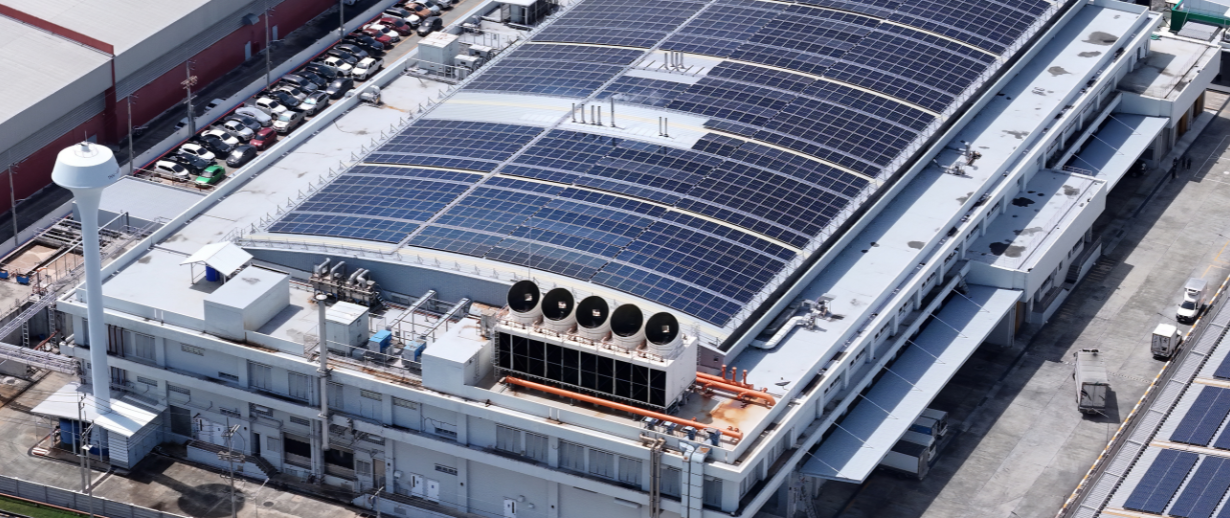
Water technologies exist to treat various water supplies, including river and recycled wastewaters, to such a high quality that, with appropriate system chemistry, we can achieve the desired water qualities. This should be a key strategy when considering the growth of the data centre market across the UK, and this is an area that can impact WUE.
Veolia can support the data centre market growth with our technologies, expertise and broad knowledge of water efficiency.
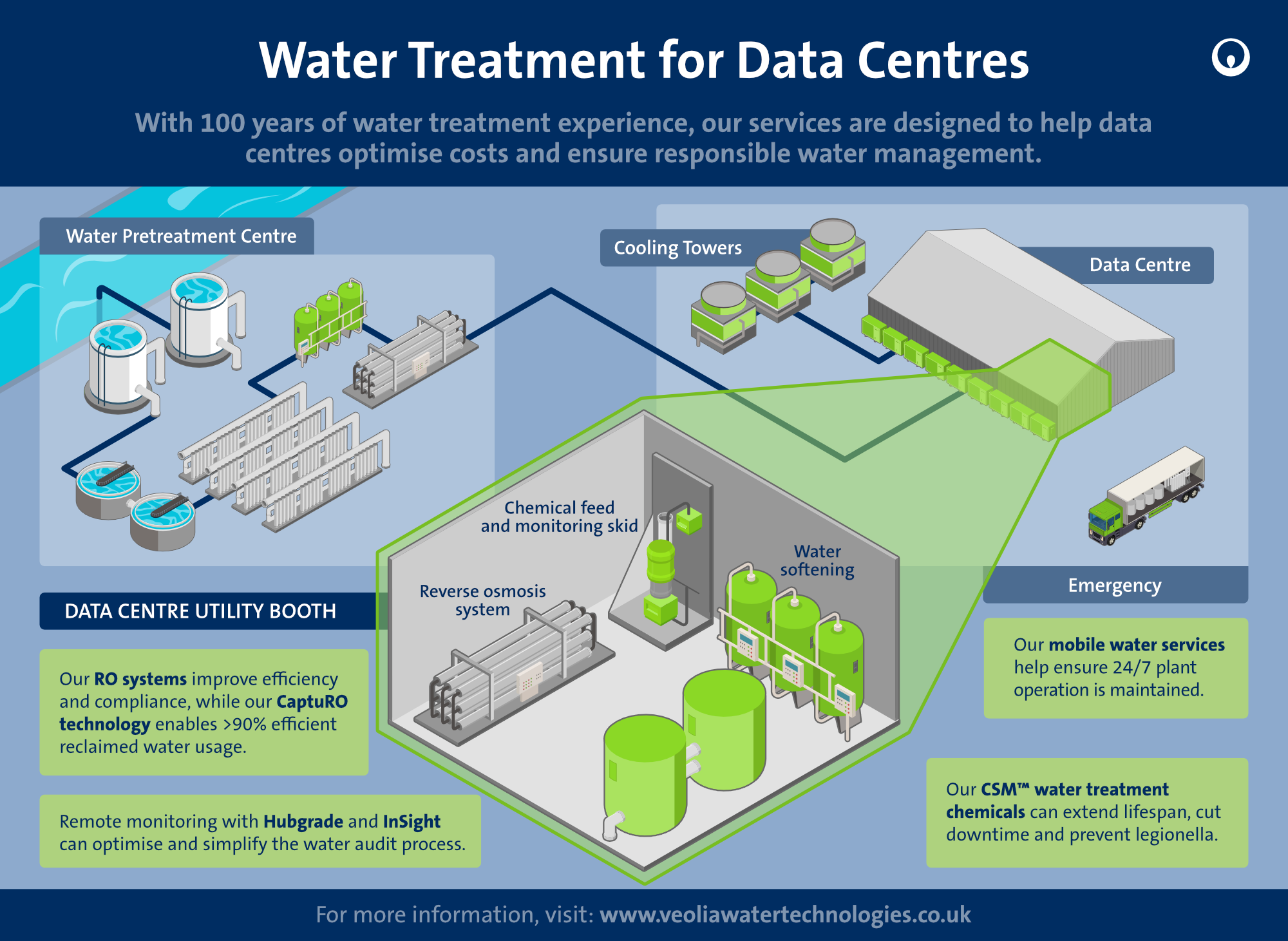
Water Audits - What we would typically associate with water stewardship. We can support you with existing or proposed facilities to assess your water efficiency to ISO46001:2019.
Water Tech Equipment - We implement high recovery rate reverse osmosis and filtration systems, plus additional technologies to meet water reuse requirements. We have extensive membrane technologies that can support water reuse or alternative water supplies.
Cooling Water Chemistry - We know that having the right chemistry is a key part for ongoing efficiency and to minimise OPEX as we utilise our cooling water technologies to maintain highly efficient heat exchange surfaces and protect against corrosion and microbiological contamination.
Non Potable Supplies - We can support the design and implementation of treatment systems for non potable make up waters, such as rainwater harvesting, all from our in-house technology portfolio.
Wastewater - should we really waste water? As an example for a data centre, Evaporative Cooling Tower Blowdown recovery and reuse should be considered, but we should also investigate non-potable supplies from nearby municipal or other industrial sites where available.
HUBGRADE - Remote cloud-based monitoring for cooling systems and water quality KPIs, providing real-time data and condition reporting.
Expertise - We can use our knowledge of all sectors of the water treatment industry, from initial design to on-site audits and water reuse options.
Mobile Water Services - For planned maintenance or emergency issues, we can also provide complete mobile water systems for all eventualities to treat incoming raw water to then produce a high-quality process water for use in data centre process and cooling water systems
For the future, we would welcome the discussion on the utilisation of immersion, which is being considered as a cooling mechanism. This will mean water quality and reliability in your water chemistry will once again be a critical consideration.
In summary, the rapid expansion of UK data centres will require some alternative thinking, and we welcome the opportunity to work with you to overcome these challenges and reduce your WUE for both new locations and the retrofit of existing centres.
Using all of the above, I hope that we can also align the market to be a strategic user of the natural resource that is water, providing economic benefits to the local communities, meeting our data needs and protecting our resources.
Get in contact with one of our water treatment data centre experts here.
References
1. Data centres: planning policy, sustainability, and resilience (Page 6: Why Have Data Centres in the UK)
2. AI and Data Centre Water Footprint in the UK: Strategic Recommendations for UK Government
3. London Assembly MQT 2025/3629 9/10/2025
4. https://committees.parliament.uk/writtenevidence/141493/pdf
Glossary
WUE - Water Usage Effectiveness
PUE - Power Usage Effectiveness
GW - Gigawatt