


Phosphorus is one of the central issues for wastewater treatment now and over the next decade. Here, Dan Parry, Head of Sales, Municipal and Industrial UK, outlines the current situation with regard to phosphorus treatment in the UK and the options for addressing this challenge.
At a Glance:
-
UK phosphorus discharge limits were tightened under the Environment Act 2021.
-
A 50% reduction in phosphorus loadings is required by January 2028 (compared to 2020 levels), progressing toward 80% by 2038.
-
Wastewater treatment works contribute an estimated 60–80% of phosphorus entering watercourses.
-
AMP8 (2025–2030) significantly increases the scale of investment in phosphorus removal.
-
Municipal and industrial operators should assess treatment capability early to ensure compliance and cost-effective delivery.
What Is Phosphorus and Why Is It a Concern in Watercourses?
Phosphorus is an important mineral; it is crucial for agriculture and essential for human health. However, excess quantities in the natural environment, especially in watercourses, can cause serious damage to aquatic ecosystems. Elevated phosphorus concentrations stimulate excessive plant and algal growth, a process known as eutrophication. This can lead to algal blooms, reduced light penetration and the depletion of dissolved oxygen as organic matter decomposes. Lower oxygen levels can stress or harm fish and invertebrate populations, disrupt ecological balance and impact overall river health. Therefore, phosphorus removal is a critical part of wastewater treatment, with progressively tightening regulatory limits driving improved water quality and supporting long-term biodiversity objectives.

While overuse of fertilisers in farming has traditionally been associated with high levels of phosphorus in rivers, effluent from wastewater treatment facilities accounts for around twice as much (60 to 80%) of the total. Therefore, there is now a particular emphasis on reducing the contribution from this source. Phosphorus was a focus of the most recent Asset Management Period (AMP7), and this focus increases significantly during AMP8 (2025–2030), where tighter phosphorus discharge permits and expanded Water Industry National Environment Programme (WINEP) schemes are driving further upgrades.
UK Phosphorus Regulations and AMP8 Requirements
In England, the tightening of phosphorus levels in treated wastewater discharged into water courses is being driven by the Environment Act 2021 and the supplementary Environmental Targets (Water) (England) Regulations 2023. This legislation sets a legally binding target to achieve a 50% reduction in phosphorus loadings to watercourses by 31st January 2028, compared to the 2020 baseline, on the way to an 80% reduction by 31st December 2038. These targets form a key part of England’s wider river basin management and nutrient reduction strategy.
For operators, this means that investment in more effective treatment and additional treatment steps is required in the coming years. This raising of standards also has an impact on some industrial businesses. For those whose wastewater has high levels of phosphorus, discharge permit conditions issued by water companies will also be tightened to support the overall goal. For both municipal and industrial applications, there are a number of options for wastewater treatment to achieve the required standards.
Phosphorus Removal Technologies for Municipal and Industrial Sites
Biological
With this type of treatment, microorganisms are grown in the water that can assimilate phosphate for growth and also absorb and store phosphorus as polyphosphate in a process called enhanced biological phosphorus removal (EBPR). The phosphorus becomes part of the biomass, which is then separated from the treated water at the end of the process.
A treatment solution based around our Cella Moving Bed Biofilm Reactor (MBBR) is ideal for municipal and industrial applications and can help to remove carbon, nitrogen and phosphorus. Cella is a highly sustainable solution that delivers excellent performance and allows the generation of biogas. Its small footprint relative to its capacity means it is suited to upgrade programmes.
Chemical
This treatment uses a metal salt, most commonly iron, to precipitate ortho-phosphate. Veolia's KlarAid range offers several options for this. Phosphate precipitation often takes place in conjunction with coagulation and using Veolia's blended products and plant-based coagulants can offer benefits. The precipitate forms as a solid and is removed in either a settlement tank or a tertiary solid capture process, such as a disc or sand filter. Our Actiflo clarifier solution utilises microsand to ballast the chemical flocs, significantly increasing the settling velocity of the particles. This delivers very short retention times and a more compact design. In fact, the footprint of an Actiflo system is as much as 40 times smaller than conventional clarifier systems.

Filtration
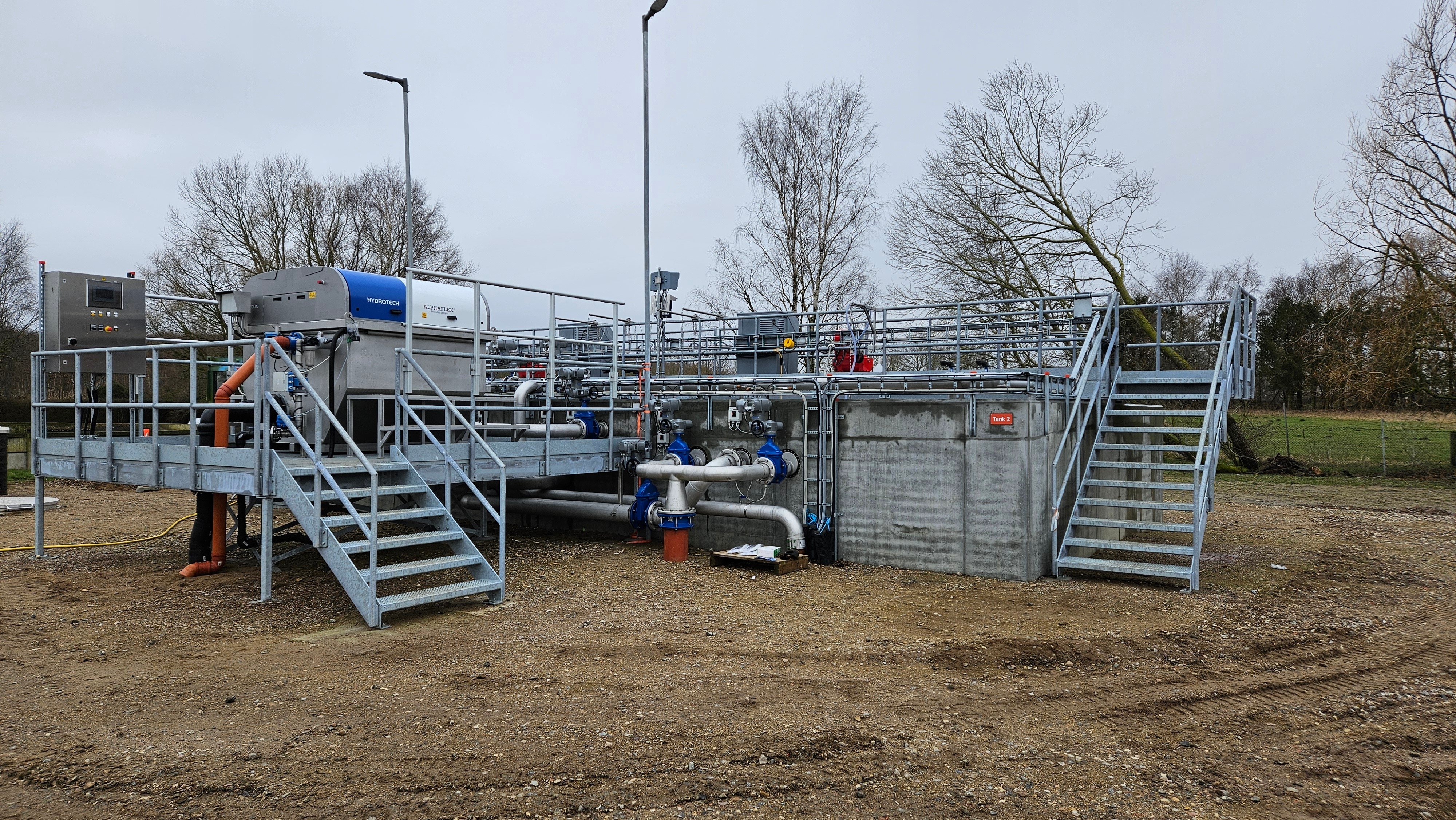
Filtration technologies – especially disc filters and pile cloth filters, thanks to their compact footprint – can provide an excellent solution for sites looking to improve the effectiveness of their treatment process to meet more stringent standards. They use a fine media mesh or cloth mounted on a number of rotating discs to effectively remove a range of contaminants. In addition, our Hydrotech Disc Filters provide a higher level of filtration for a smaller footprint than many standard drum or disc filters. This is especially true for the Hydrotech Cloth Filter, which uses a pile filter material mounted on the Hydrotech disc filter frame. This unique design allows more suspended solids to be trapped in the pile fibres, achieving a nominal particle removal of 5 microns – enabling a robust phosphorus reduction. These filters also offer a flexible and modular solution with a comparatively low TOTEX – the total expenditure combining CAPEX and OPEX.
There are also solutions, such as our ZeeWeed membrane bioreactor (MBR), that combine biological treatment with high-grade filtration to achieve very high levels of water quality. The ZeeWeed MBR features an ultrafiltration (UF) membrane, which will not only remove suspended solids and nutrients, but also bacteria and viruses, to achieve reuse-quality water.
Hubgrade - Advanced Control
Alone, or in combination with one or more of the above solutions, Veolia's Hubgrade solution offers an opportunity to comply with stricter phosphorus requirements with the lowest possible CAPEX and/or OPEX.
Hubgrade automatically optimises the operation of treatment plants in real time. The control systems collaborate and combine internal and external data sources across the treatment plant with predictive analytics, thereby achieving holistic optimisation, which provides:
-
Increased biological capacity, which can be used for increased biological phosphorus removal, even in treatment plants not designed for biological phosphorus removal. This allows savings in physical expansions (CAPEX), as well as precipitation chemicals and thus also handling of chemical sludge (OPEX).
-
Improved fertiliser value of the sludge, if it is applied to agricultural land. Biologically bound phosphorus is released more easily to crops than chemically bound phosphorus.
-
In addition to reducing the need for precipitation chemicals through increased biological phosphorus removal, Hubgrade also ensures optimal dosing of necessary precipitation chemicals, so that neither too much nor too little is dosed (OPEX).
Partnering for Effective Phosphorus Compliance
Choosing the right solution based on the exact requirements of the site is essential to ensure an effective and cost-effective approach. As a leading water treatment specialist, our expert team will be able to provide guidance on the most appropriate technologies for each site based on decades of knowledge and experience at sites in every area of the world. We also have a wide range of solutions, meaning, unlike some, we can truly offer the right technology for every application.
Speak to one of our experts about how we can assist you with your site's phosphorus removal, HERE.

Author | Daniel Parry
Daniel spent the first 10 years of his career managing proposals for large EPC (Engineering Procurement & Construction) power projects. Daniel has been with Veolia Water Technologies for 7 years where he has managed the proposals for Industrial and Municipal projects. Daniel also now manages the sales team for Industrial Wastewater opportunities ensuring that Veolia Water Technologies work with each customer to design and deliver the most appropriate solution for their needs.