---
title: The four critical water quality tests every pharmaceutical lab must monitor
description: Discover the four key water quality tests (TOC, Bioburden, Endotoxins, and Conductivity) that ensure pharmaceutical lab compliance and product safety.
image: https://blog.veoliawatertechnologies.co.uk/hubfs/Blog%20-%20featured%20image%20-%20HUBSPOT%20(6).png
---
[Skip to content](https://blog.veoliawatertechnologies.co.uk/the-four-critical-water-quality-tests-every-pharmaceutical-lab-must-monitor-5#main-content)
- UNITED KINGDOM
- [Online shop](https://uk.shop.veoliawatertechnologies.com/?__hstc=87449607.217c47630b00f349d55659f70d7b5bb6.1714376476665.1714481227412.1714485265865.4&__hssc=87449607.5.1714485265865&__hsfp=1840189571&_gl=1*1p02bir*_ga*ODg3MDc2Mzc1LjE3MTQzNzY0NzU.*_ga_Y5BN5GRTLT*MTcxNDQ4NTI2NS4zLjEuMTcxNDQ4NzQyMi41Ny4wLjA.)
- [Other Veolia sites](http://www.veoliawatertechnologies.com/en/about-us/multi-local-presence?__hstc=87449607.217c47630b00f349d55659f70d7b5bb6.1714376476665.1714481227412.1714485265865.4&__hssc=87449607.5.1714485265865&__hsfp=1840189571)
[](https://veoliawatertechnologies.co.uk/)
- Explore Water Treatment
- [ Markets](https://www.veoliawatertechnologies.co.uk/markets)
- [ Applications](https://www.veoliawatertechnologies.co.uk/applications)
- [ Technologies](https://www.veoliawatertechnologies.co.uk/technologies)
- [ Products](https://www.veoliawatertechnologies.co.uk/products)
- [ Services](https://www.veoliawatertechnologies.co.uk/services)
- [Customer Services](https://www.veoliawatertechnologies.co.uk/customer-services)
- [About Us](https://www.veoliawatertechnologies.co.uk/about-us)
- [Careers](https://www.veoliawatertechnologies.co.uk/careers)
- News & Resources
- [ Blog](https://blog.veoliawatertechnologies.co.uk)
- [ Events](https://www.veoliawatertechnologies.co.uk/events)
- [ Webinars](https://www.veoliawatertechnologies.co.uk/webinars)
- [ News](https://www.veoliawatertechnologies.co.uk/news)
- [ Resources](https://www.veoliawatertechnologies.co.uk/tech-resources)
- [ Case Studies](https://www.veoliawatertechnologies.co.uk/case-studies)
- [Contact](https://www.veoliawatertechnologies.co.uk/contact)
- Explore Water Treatment
- [ Markets](https://www.veoliawatertechnologies.co.uk/markets)
- [ Applications](https://www.veoliawatertechnologies.co.uk/applications)
- [ Technologies](https://www.veoliawatertechnologies.co.uk/technologies)
- [ Products](https://www.veoliawatertechnologies.co.uk/products)
- [ Services](https://www.veoliawatertechnologies.co.uk/services)
- [Customer Services](https://www.veoliawatertechnologies.co.uk/customer-services)
- [About Us](https://www.veoliawatertechnologies.co.uk/about-us)
- [Careers](https://www.veoliawatertechnologies.co.uk/careers)
- News & Resources
- [ Blog](https://blog.veoliawatertechnologies.co.uk)
- [ Events](https://www.veoliawatertechnologies.co.uk/events)
- [ Webinars](https://www.veoliawatertechnologies.co.uk/webinars)
- [ News](https://www.veoliawatertechnologies.co.uk/news)
- [ Resources](https://www.veoliawatertechnologies.co.uk/tech-resources)
- [ Case Studies](https://www.veoliawatertechnologies.co.uk/case-studies)
- [Contact](https://www.veoliawatertechnologies.co.uk/contact)
- [Online Shop](https://uk.shop.veoliawatertechnologies.com/)
- [Other Veolia Sites](https://www.veoliawatertechnologies.com/en/about-us/veolia-water-technologies/veolia-water-technologies-around-world)
- [Login](https://www.veoliawatertechnologies.co.uk/services/customer-portal-remote-monitoring)
- [Cookie Policy](https://www.veoliawatertechnologies.co.uk/cookie-policy)
- [Terms & Conditions](https://www.veoliawatertechnologies.co.uk/legal-0)
- [Privacy Policy](https://www.veoliawatertechnologies.co.uk/privacy-policy)
- [Modern Slavery Statement](https://www.veoliawatertechnologies.co.uk/modern-slavery-and-human-trafficking-statement)
- [Site Map](https://www.veoliawatertechnologies.co.uk/sitemap)
TOP
.png)
[ Back](https://blog.veoliawatertechnologies.co.uk)
- [Ultrapure Water](https://blog.veoliawatertechnologies.co.uk/?tid=199759305967)
- Connect with us
-
-
-
# The four critical water quality tests every pharmaceutical lab must monitor

by Veolia Water Technologies
03 October 2025
6 minutes read
[ Back](https://blog.veoliawatertechnologies.co.uk) Follow
**Monitoring plays a vital role in all aspects of water management, from municipal to manufacturing. However, in pharmaceutical laboratories, where accuracy, repeatability and customer health are so crucial, accurate pharmaceutical water testing of pure water samples is paramount. Here, we examine the four key testing parameters for pharmaceutical labs (TOC, Bioburden, Endotoxins and Conductivity) and explore some of the technologies we offer to support your work with efficient, reliable results and guaranteed quality assurance.**
# **The importance of accurate testing**
In the pharmaceutical industry, water is the most utilised material. Its applications range from serving as a product base to facilitating releases and ensuring essential equipment cleaning. Because many pharma products are injected directly into the bloodstream or used by customers with potentially damaged or depleted immune systems, the consistency of water purity used in pharmaceutical production needs to be high, and testing needs to be rapid and reliable.
Failure to comply with the EU, US or Japanese pharmacopoeias can come from a number of sources, but four key testing parameters form the basis of pharmaceutical contamination and reduce the likelihood of compliance.

**➡️ TOC**
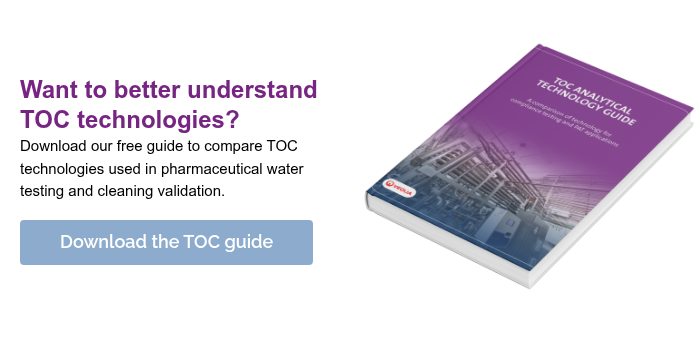
TOC (Total Organic Carbon) is the level of organic compounds found in a water sample and is a crucial test for all ultrapure water in pharmaceutical applications. High levels of TOCs can indicate contamination of the water source or malfunctioning equipment, which in turn can compromise product purity, cause undesirable chemical reactions and lead to the proliferation of microbes. Consequently, regular TOC testing is vital to ensure that levels in pure water do not exceed the 500ppb or 0.500mg/L that serves as the acceptable threshold across the leading pharmacopoeias. *\[sources [1](https://cptclabs.com/pharmaceutical-water/) & [2](https://www.google.com/url?q=https://www.altusscience.com/news/what-is-total-organic-carbon-why-is-its-measurement-important-in-pharmaceutical-applications/%23:~:text%3DAll%2520chapters%2520state%2520a%2520nominal,is%2520to%2520improve%2520patient%2520safety&sa=D&source=docs&ust=1753285925014899&usg=AOvVaw2aZU2oA3rIkF3RPAcqRbdj)\]*
*[](https://blog.veoliawatertechnologies.co.uk/hs/cta/wi/redirect?encryptedPayload=AVxigLKkbVbL8dVqjwcYBnBgGSx8HNIOCULSFjJYV4f5Ef5yKIMJhg4HXFmFcxydOM3TidZoR%2Fuhxor%2Ba4fO%2F7j2qnJwBipt7J6b%2B%2BrFyp1TtWa%2FDJiecOnYRlObSzKKVbbg1N17Em3b2UNZESgk5e2MDBBpIBCSoTH6wL%2FG0vEq5I%2FjUeXozfkhy7qRPM34G8PAkfbxnkRSWTiwSxjEIbdxzH9M1Mm2egjWdpku2Ih6TuLNwe1Eh2bGrYs%2B87sfsiShZSM8a%2BYU9FTrGb31uokML8MpNDgWsgGD8bvGsceFGT58KQH8Wcsfmaj1ysLVwKC12uI%3D&webInteractiveContentId=450818980037&portalId=25605683)*
**➡️ Bioburden**
Bioburden is the load of viable microbial life found in a sample. Regular testing for bioburden is a vital process in pharmaceutical labs as it reduces the likelihood of dangerous contamination and helps to establish that the sterilisation process will work as intended. Different stages of the production process need to be fulfilled with low bioburden levels, to meet the pharmacopeæ requirements of 10 CFU/100 ml. *\[sources [1](https://www.google.com/url?q=https://www.americanpharmaceuticalreview.com/Featured-Articles/590786-What-Counts-Establishing-a-Bioburden-Strategy-for-a-New-Pharmaceutical-Product/&sa=D&source=docs&ust=1753285925016006&usg=AOvVaw0iET7Xcjh4-156dED4Gc4d) & [2](https://www.google.com/url?q=https://www.ema.europa.eu/en/documents/scientific-guideline/guideline-sterilisation-medicinal-product-active-substance-excipient-and-primary-container_en.pdf&sa=D&source=docs&ust=1753285925016034&usg=AOvVaw318HwHCoLH1O09t_eh7MVL)\]*
**➡️ Endotoxins**
Endotoxins are the main component of the outer membrane of Gram-negative bacteria and serve as an indicator of potentially harmful microbial contamination. Controlling the non-presence of endotoxins in pharmaceutical products is vital, as they can cause fever, shock or worse, can lead to death. *\[sources [1](https://www.google.com/url?q=https://www.ema.europa.eu/en/documents/scientific-guideline/draft-ich-guideline-q4b-annex-14-note-evaluation-and-recommendation-pharmacopoeial-texts-use-ich-regions-bacterial-endotoxins-tests-general-chapter-step-3_en.pdf&sa=D&source=docs&ust=1753285925017525&usg=AOvVaw1MfyhXJDRY-eatcIJv-8rm) & [2](https://www.google.com/url?q=https://www.ema.europa.eu/en/documents/scientific-guideline/draft-ich-guideline-q4b-annex-14-note-evaluation-and-recommendation-pharmacopoeial-texts-use-ich-regions-bacterial-endotoxins-tests-general-chapter-step-3_en.pdf&sa=D&source=docs&ust=1753285925017558&usg=AOvVaw0VAhyY4hgj-Lk0J-ds9IGK)\]*
**➡️ Conductivity**
Conductivity is a fundamental indicator of ionic contamination in purified water, and a core requirement of all major pharmacopoeias (USP, EP, JP). It is used to assess the presence of inorganic impurities, such as residual salts or minerals, that may compromise product safety or process integrity. By implementing continuous conductivity measurement and automated alarms, labs can ensure rapid detection of deviations and maintain GMP-compliant water quality at all times.
# **Why trusted water quality data matters**
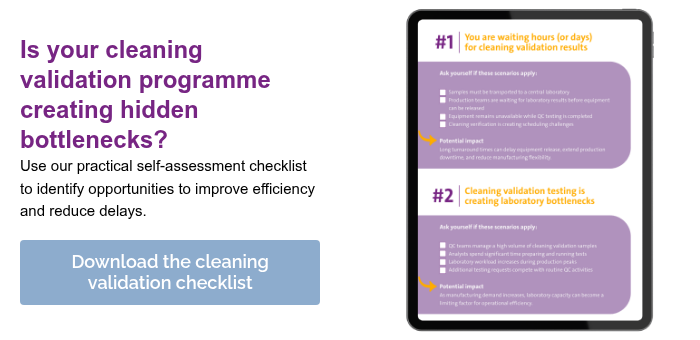
Testing pharmaceutical water is not simply about meeting regulatory requirements. Every result generated contributes to critical quality decisions, including equipment release, cleaning validation approval, water quality monitoring and product quality assurance. When testing methods are slow, difficult to manage or produce inconsistent results, laboratories may face:
\> Delayed decision-making
\> Increased investigation workload
\> Reduced operational efficiency
\> Greater compliance risks
As pharmaceutical manufacturers continue to focus on data integrity and process understanding, confidence in water quality data becomes increasingly important.
# **Operational challenges for labs**
The necessary TOC, bioburden, endotoxin, and conductivity tests pose a significant operational challenge for pharmaceutical labs, as each test must meet strict GMP compliance and pharmacopoeia demand. It must also be possible to deliver the tests within a time frame that makes production feasible and pharmaceutical water quality monitoring accurate.
Data integrity is also another key consideration, as regulatory bodies like the FDA (Food and Drug Administration) and the EMA (European Medicines Agency) place an increasing importance on the generation of data throughout the lifecycle of pharmaceutical products, from R&D to manufacture.
Consequently, there is high demand for equipment that delivers reliable testing alongside straightforward compliance reporting and an efficient testing process. Fortunately, we offer a complete range of products that provide industry-leading testing within an accelerated timeframe, as well as a simple reporting process.
[](https://blog.veoliawatertechnologies.co.uk/hs/cta/wi/redirect?encryptedPayload=AVxigLLZqtAvr%2FsaZmMvQha8YXDD%2FpIZZhwnhHghHhKVTQgfO%2F1n%2FV%2FXg%2BuF4D6uPm63vFUaYnhpgtj890T%2F0xxPUNK6E4ZQPck5%2BYZ6u3G7QWjga2ykH1X4OaSMDtxbDfk%2FDrLb8Xljlwt7ND%2BsvqbPfS%2F14Vt9flXylcKY2uk%2BrsTN6fukTyIJJH6rZ7fbIGdVkHZiFgWkCxIwqplmH1hvwGrpT733%2Fq9HJozqKIU0T%2Bll0E%2BMtgW4o6VCbWQR0SDNbq9ihE%2BaHCG83%2FFZ8YhPaohTBKdxP5U2jgphjR7zKwb5GGfJIhAxiGvmjM3XOSCtfcJsMznTKvdQ0DxyJq0ezWb1cbDNmnlt&webInteractiveContentId=450818980047&portalId=25605683)
**💧 TOC testing**
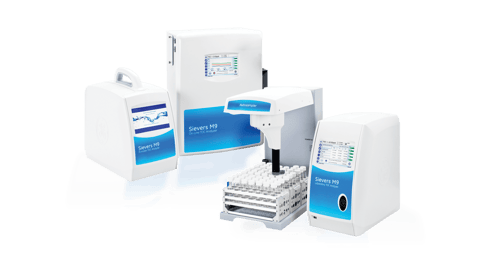
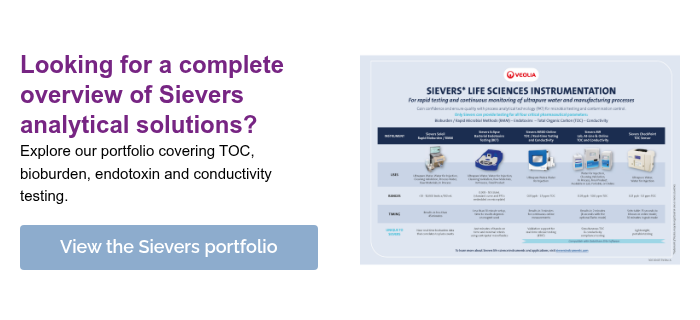
We offer several products to help maintain regulatory compliance and quality management when it comes to TOC analysis. The M9 TOC Analyzer range boasts unparalleled speed with its optional turbo mode, completing analyses in just four seconds, whilst maintaining high levels of accuracy. The Sievers M9 is leading the industry with TOC data transfer, data security, and data management features to support compliance with 21 CFR Part 11 of the FDA regulations and other Pharmacopoeia Data Integrity guidelines.
**💧 Bioburden testing**
Traditional bioburden testing methods, such as plate counts, are often too slow to be effectively incorporated into process monitoring and product release. However, with our Sievers Soleil Rapid Bioburden Analyzer, test results can be achieved in less than 45 minutes. This is thanks to our Rapid Microbiological Method (RMM), the first of its kind, able to correlate accurately the plate counts, with the use of unique reagents, viability stains and high throughput flow cytometry to distinguish viable cells from particles.
**💧 Endotoxin testing**
Historically, endotoxin testing has been a labour-intensive process that is prone to error. In contrast, the Sievers Eclipse Endotoxin Testing System provides a time saving of up 85% with its nine-minute setup for a 21-sample assay, all whilst complying with USP \<85\>, EP 2.6.14 and JP 4.01. Furthermore, because it draws upon a compendial endotoxin assay using microfluids, it uses up to 90% less LAL or rLAL, providing a significantly more sustainable alternative to traditional testing.
💧 Conductivity Testing
Purified water testing and water for injection testing are basic yet essential parts of any pharmaceutical water quality programme. They are used for continuous verification of ionic purity and system integrity, particularly for Purified Water (PW) and Water for Injection (WFI) systems. Most of our purification systems include inline conductivity sensors that deliver real-time data with high sensitivity and reliability. These are integrated into a validated monitoring system, supporting compliance with pharmacopoeial limits.
[](https://blog.veoliawatertechnologies.co.uk/hs/cta/wi/redirect?encryptedPayload=AVxigLKi41rh1x7lFvoeKvXADbZq7Drs8ITVnfXhjuJy7dyh5Td2UqVtWQTMZNHDVd4sibFmPz4xQSKg52v94cjuwVJcZUHimjM7ixaqQ7foPiccyU0qkZk6tOGRIa9f1GhikRj0jitesZar77UYEleVNNhNRHJ3Vc%2FMW0sGMF6fA3K2NTNC6ft6g2DDQRQlS%2FZ2THjJN0Q0dQQIvZ%2FupkzAA21kN%2BJzyO9blkmSOoCUFD4u2ByBqE0Ywy6dc6%2FP8UB3xPcd08j%2BUZ1FWSmOnsdoAPeGo%2BN3A9pPnv31abICu331qQ%3D%3D&webInteractiveContentId=450818980053&portalId=25605683)
## Tags
- [Ultrapure Water](https://blog.veoliawatertechnologies.co.uk/?tid=199759305967)
## Related articles
## Discover *VWT UK*
### Latest news
[News](https://veoliawatertechnologies.co.uk/news/)
### Latest webinars
[Webinars](https://veoliawatertechnologies.co.uk/webinars/)
### Upcoming events
[Events](https://veoliawatertechnologies.co.uk/events/)
### Latest resources
[Resources](https://veoliawatertechnologies.co.uk/tech-resources/)

## Sign up to blog notifications
Receive the latest blog updates.
{|error|}
By checking this box, you agree to **Veolia Water Technologies's** [Privacy Policy](https://veoliawatertechnologies.co.uk/privacy-policy) and you agree to receive information on our products and services.
Keep me informed
We respect your right to privacy. Click here to view our [contact policy](https://veoliawatertechnologies.co.uk/privacy-policy).
## Thank you for subscribing.
Please note that you can update your **preferences** at any time.
Return to blog
Note: If you do not receive any emails, please check your junk folder.
```json
{
"@context" : "https://schema.org",
"@type" : "BlogPosting",
"author" : {
"@type" : "Person",
"name" : "Veolia Water Technologies",
"url" : "https://blog.veoliawatertechnologies.co.uk/author/veolia-water-technologies"
},
"dateModified" : "2026-08-10T16:27:17.335Z",
"datePublished" : "2025-10-03T12:40:29.000Z",
"headline" : "The four critical water quality tests every pharmaceutical lab must monitor",
"image" : [ "https://blog.veoliawatertechnologies.co.uk/hubfs/Blog%20-%20featured%20image%20-%20HUBSPOT%20(6).png" ],
"mainEntityOfPage" : {
"@id" : "https://blog.veoliawatertechnologies.co.uk/the-four-critical-water-quality-tests-every-pharmaceutical-lab-must-monitor-5",
"@type" : "WebPage"
},
"publisher" : {
"@type" : "Organization",
"logo" : {
"@type" : "ImageObject",
"url" : "https://blog.veoliawatertechnologies.co.uk/hubfs/header-logo.png"
},
"name" : "Veolia Water Technologies"
}
}
```