
-100.jpg)

For the power generation sector, improvements in productivity, cost and operational continuity are essential in order to meet the growing challenges faced by the industry. Worldwide demand for sustainable power generation is rapidly growing, but so are the pressures. These include tightening environmental regulations, water scarcity, and the need to protect expensive assets from scaling and corrosion. However, with the proper implementation of an effective and reliable demineralised water solution, positive steps can be taken.
Why is water important for the power industry?
A reliable and top-notch source of purified water is absolutely vital for the power industry for boiler feed and gas turbine injection. Subpar water quality causes boiler scaling, turbine corrosion, and unplanned downtime, with each incident potentially costing hundreds of thousands in lost revenue.
Power plants require highly purified or demineralised water because even trace amounts of dissolved minerals, silica, oxygen, chlorides, sodium, or other contaminants, can damage critical equipment operating under high temperatures and pressures. Maintaining strict water quality helps maximise thermal efficiency, protect valuable assets, and ensure consistent power generation while reducing maintenance costs.
Traditional demineralised water systems often require long lead times, complex installation, and chemical regeneration, creating operational bottlenecks for power plants facing urgent water quality challenges. These systems also demand ongoing maintenance, chemical handling, and periodic regeneration cycles, all of which increase operational complexity and can limit flexibility during periods of increased demand.
For power plants, this delay is costly because poor water quality directly impacts electricity output:
- Boiler scaling - Reduces heat transfer efficiency by allowing mineral deposits to build up on heat exchange surfaces. Even a thin layer of scale significantly decreases heat transfer, forcing plants to burn more fuel to achieve the same steam production while increasing operating costs and emissions.
- Turbine blade corrosion - Impurities carried in steam can contribute to corrosion and deposition on turbine blades, degrading aerodynamic performance, reducing generation capacity, and shortening component life.
- Unplanned maintenance shutdowns - Poor water chemistry accelerates wear on boilers, turbines, condensers, and associated equipment, leading to unexpected outages. Each incident can cost hundreds of thousands in lost revenue, while also increasing maintenance expenditure and reducing plant availability.
For thermal power plants operating on tight margins, these failures translate directly to lost megawatts and lost revenue. Maintaining a continuous supply of high-purity water is therefore essential not only for protecting expensive assets, but also for improving efficiency, extending equipment life, meeting environmental and operational performance targets, and ensuring reliable electricity generation.
Our TERION Demineralised Solution
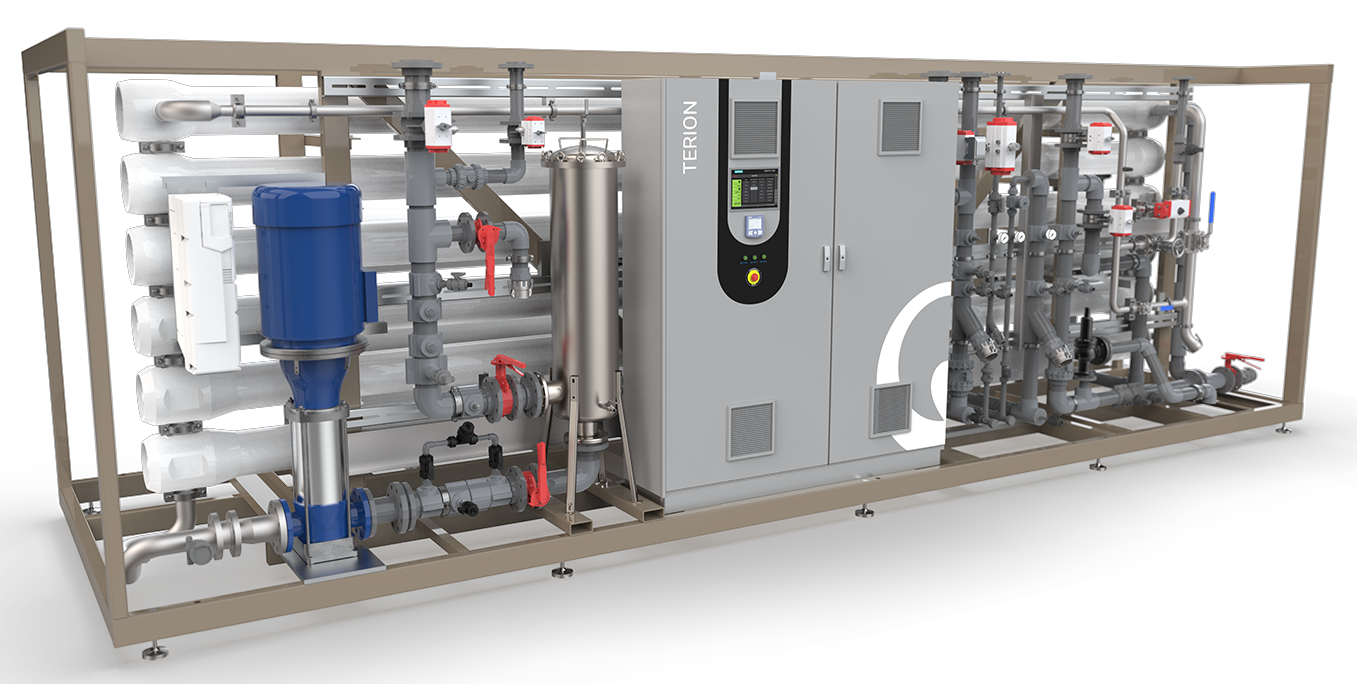
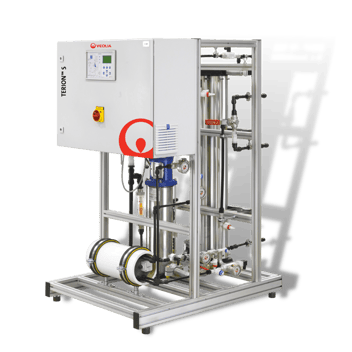
Our TERION* demineralised water solution has been designed to meet the strict quality standards and water volumes required by industrial and power sector businesses. Unlike traditional systems, TERION is pre-assembled, containerized, and ready for plug-and-play deployment. TERION combines Reverse Osmosis (RO) and Continuous Electrodeionisation (CEDI) technologies in a single unit. It can remove over 99.9% of dissolved inorganics and over 99% of large dissolved organics to meet the most stringent water quality specifications. The range includes units that can produce between 5 m3/hrh and 52 m3/hr of treated water. For applications with reduced water volume requirements, we have our TERION S, which can produce from 110 up to 4,000 ltr/hr.
Reducing capital and operational costs is also an important consideration. The configuration of the RO and CEDI units into a single pre-assembled frame and testing the unit before it is dispatched reduces installation and commissioning time. This plug-and-play approach means power plants can deploy TERION in weeks rather than months.
The use of Variable Frequency Drive (VFD) pumps and high-efficiency motors means energy usage is reduced by up to 50%. Also, the continual electrical regeneration of the resin beds within the CEDI means the additional cost and risk associated with the acid or caustic chemicals required for traditional ion exchange systems, is eliminated.
The TERION S and TERION can both be integrated with remote monitoring and optimisation platforms such as our Hubgrade Digital Services. This can help improve the efficiency of the water treatment system, reducing costs further, streamline its management with automated alerts and notifications and also provide real-time monitoring of all your building’s systems.
Most importantly, our engineering and technical support teams are on hand to provide help and guidance at each step of the process from initial specification through to ongoing system support and maintenance.
Click here to find out more about our TERION range.
*Trademark of Veolia; may be registered in one or more countries.

Author | Kalpesh Shah
Kalpesh Shah is the Industrial Sales Manager for Veolia Water Technologies UK. He started out working within internal sales in the early 90's before moving into international sales. In 2000, his focus led him into project management where he worked on a variety of complex and demanding projects with clients ranging from the NHS, Industrial and Pharmaceutical, for over a decade. He then moved into pharmaceutical business development which he did successfully until his promotion to Industrial Sales Manager. Kalpesh has 26 years of extensive experience with all types of industrial water treatment systems and processes. He is able to support his clients with the design and implementation of efficient water treatment systems using an array of technologies.