

Pharmaceutical manufacturers face a number of challenges, including the need to balance their demand for high-quality, compliant purified water with the drive for sustainability. Etienne Arman, Pharmaceutical Account Manager at Veolia, recently spoke at the Making Pharmaceuticals conference on the issues facing manufacturers – what can be done to address these, and what the future holds. Here, he answers some of the key questions around this topic.
What makes the pharmaceutical industry different in how it utilises resources?
From lab-scale drug development to mass production of medicines and medical devices, everything in the pharmaceutical industry is highly regulated. To achieve such stringent standards, extra steps and measures are often necessary, along with all the relevant supporting documentation.
In addition, all pharmaceutical operations are critically dependent on clean utilities: Purified Water (PW), Water For Injection (WFI), clean or pure steam, compressed air, cleanroom HVAC, speciality gases, and other vacuum systems – all of which typically have a higher carbon footprint.
Maintenance is another area where resources are an important consideration. Even though we’ve made considerable progress in technologies and engineering design over the past few decades, the pharmaceutical industry remains predominantly focused on time-based preventative maintenance rather than throughput- or outcome-based operations, the latter being typically less resource-intensive.
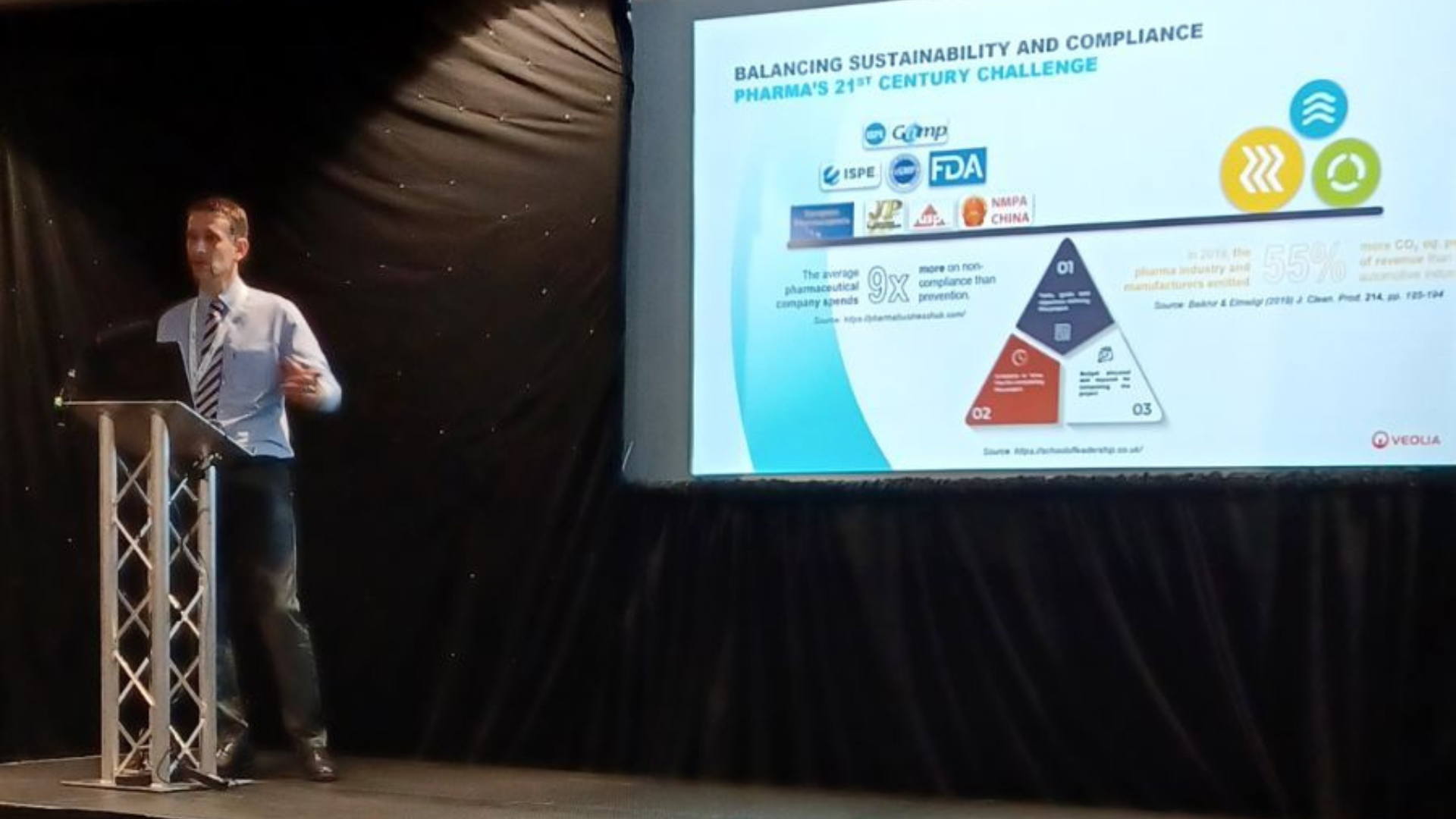
This all contributes to the finding, published in 2019, that the pharmaceutical industry emits 55% more CO2 equivalent per million dollars of revenue (CO2 eq. per M$) than the automotive industry 1.
What is the link between water and carbon emissions? And why is it so important?
Water is arguably one of the most complex resources for pharmaceutical manufacturers to manage. It is in itself a valuable commodity, but the treatment of water – including the purification of process and ingredient water, and the treatment of wastewater – also has a carbon impact.
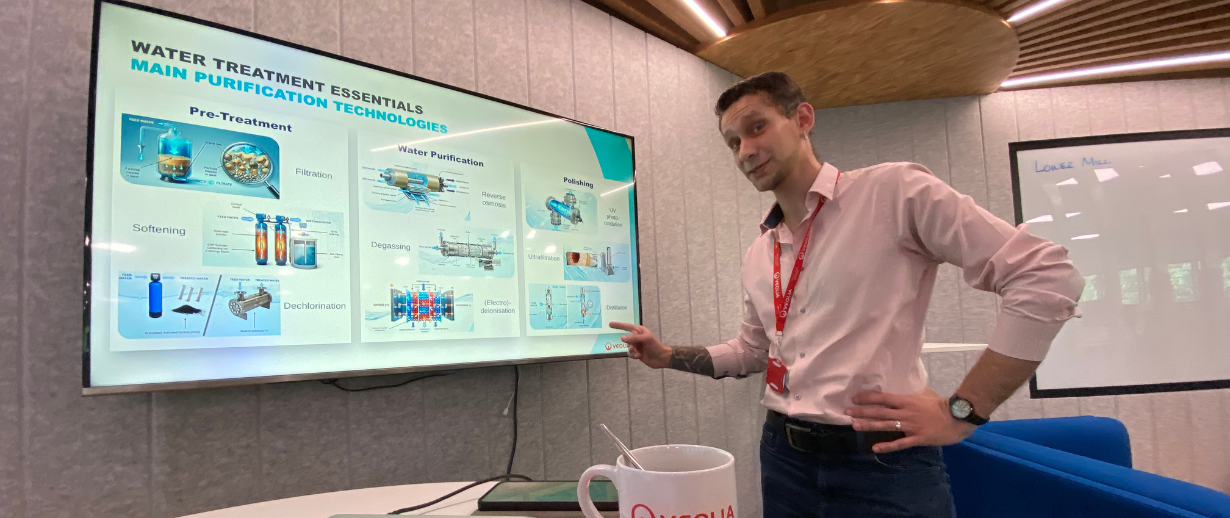
.jpg?width=489&height=652&name=IMG_1200%20(1).jpg)
Every stage of the purification journey adds to the product water’s carbon footprint, and there are several types of carbon impact to consider. The easiest to quantify is the operational carbon, which encompasses the energy required to run the system’s pumps, valves and heat exchangers, as well as the consumables (filters, resins and membranes) that need to be changed periodically. We must also consider the fact that some unit operations, such as reverse osmosis, electro-deionisation and filter backwashes, also send a portion of water to drain. However, leading manufacturers like Veolia have made advances to minimise this waste.
There is also embodied carbon, the emissions associated with the production of the purification equipment. This includes everything from the extraction of raw materials to manufacture to transport and installation.
Additionally, regular preventative maintenance visits by a trained field service engineer, as well as any call-outs necessary to keep the system running, usually within a short response window, all add to the system’s carbon footprint.
Therefore, the relationship between carbon and purified water footprint is highly design- and application-dependent. When it comes to water usage, every site is unique, with a common denominator that we must strive to improve how we consume our most precious resources.
What are the key technologies that can help reduce the carbon impact of purified water?
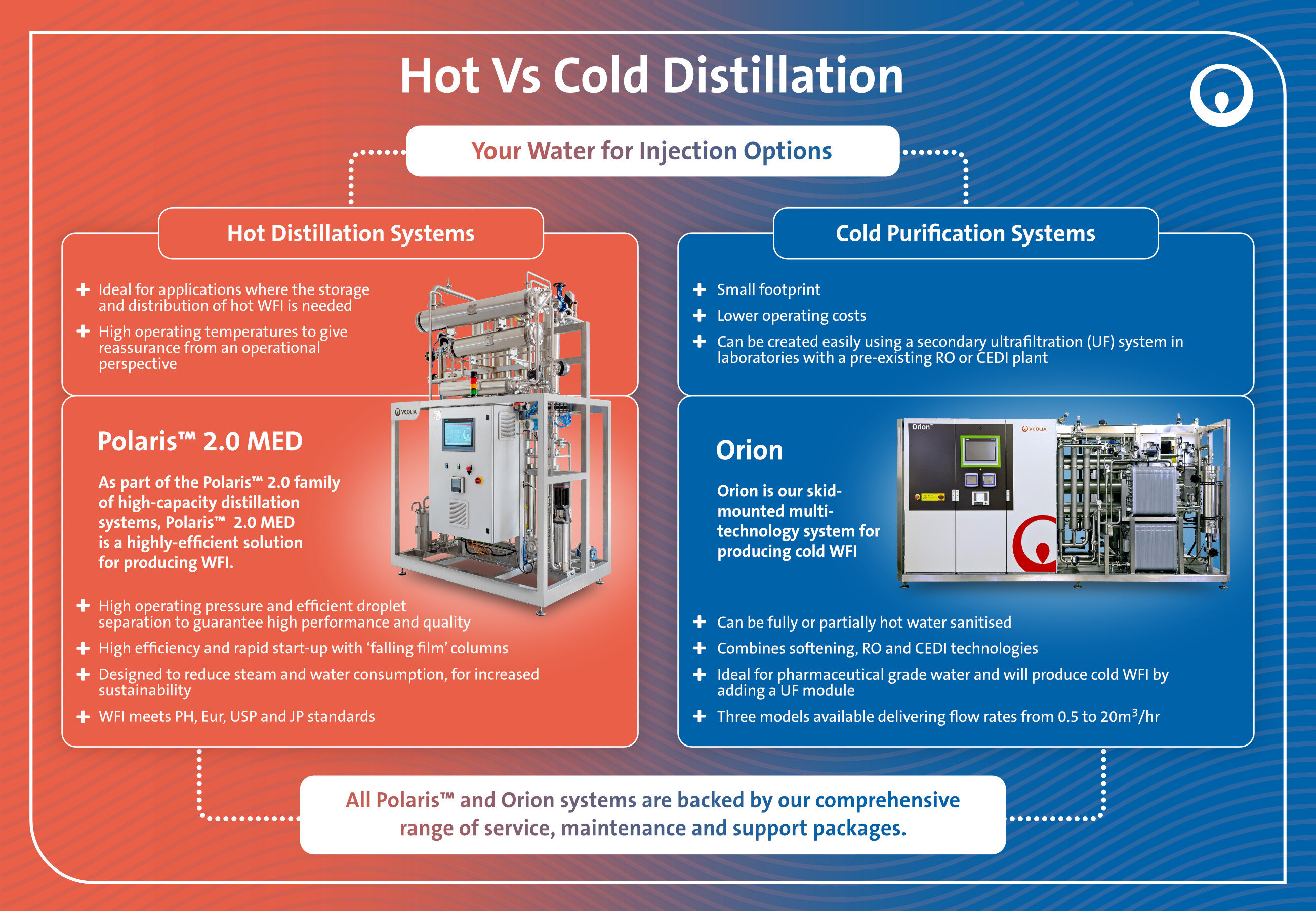
The worst thing you can do is to heat water without needing to. Distillation systems require very large amounts of energy, mainly due to the large latent heat of vaporisation; it takes seven times more energy to evaporate 1kg of water from 15°C, than to simply heat it up to 100°C.
.jpg?width=694&height=520&name=IMG_1190%20(1).jpg)
This is why the use of Cold WFI systems is on the rise, now that all major pharmacopoeias have allowed the production of Water for Injection via dual membrane systems as well as traditional stills. On top of the financial and environmental benefits of avoiding the distillation process, Cold WFI systems also represent a significant gain in efficiency and space. However, Cold WFI does give rise to new requirements. The most important being to control the microbiological load downstream from the water purifier, usually by ozonation or periodic heat sanitisation, as well as Total Viable Count (TVC) and Total Organic Carbon (TOC) trending. And beyond the technology, it’s data that keeps on ruling the world: reliable records and control systems avoid having to dump non-compliant water, help keep reactive maintenance to a minimum, and effectively underpin product and patient safety across the entire value chain.
Are there any operational considerations for increasing sustainability?
It all begins with a value-added design, which puts the emphasis on long-term serviceability and sustainability. A system conceived in isolation is only as good as the sum of its parts, whereas a system that answers a precise User Requirement Specification, with an accurate demand profile and robust KPIs, can be optimised in several ways and embedded into the facility’s Environment, Health, and Safety (EHS) strategy.
Over the lifespan of the asset, we expect to spend thousands of hours servicing it, replacing parts and consumables, and calibrating instruments, which is why the link between our process engineering and field service teams is so crucial to the asset’s long-term performance. At Veolia, we are now moving into a predictive maintenance mentality, whereby our digital teams monitor asset performance remotely and communicate with our technical support experts to resolve events before they become issues for our customers. With more than 600 assets connected in the UK, we have saved more than 11T CO2eq. in 2025 alone by preventing breakdowns – with the obvious benefit of added peace of mind for our customers.
Wastewater management is also increasingly important. What are the factors driving changes in this area?
It is a well-known fact that pharmaceutical effluents are amongst the most complex to treat. Not only do they vary greatly in composition and volume over time, because most plants produce batches to demand, but they also contain potent – and often undisclosed – bioactive compounds. This is why many manufacturers work with water treatment specialists such as Veolia. Larger sites tend to have their own effluent treatment plants, often composed of primary buffer tanks feeding secondary bio-digestion assets where bespoke mixtures of bacteria slowly degrade the large variety of organic substrates.

However, the Extended Producer Regulations being introduced in Europe now puts the emphasis on substances that may be able to travel through secondary and even tertiary treatments, and therefore would cause lasting effects in the environment (e.g. PFAS, microplastics etc.) If the UK follows suit, from a compliance and competitiveness standpoint, the cost of effluent treatment is bound to increase significantly, which will likely encourage pharmaceutical manufacturers to consider the degree of treatment they carry out in-house versus other more expensive forms of contractual disposal.
What can we do to better understand and reduce the water footprint of a site?
This is where we need to change our game strategy. So far, many industries have been operating on the premise of leak detection and continuous improvement: identify the biggest sources of waste and optimise these particular supply points or unit operations. But as always, knowledge is king – and data its faithful knight. It is now possible to map out a site’s various water streams over time, such as mains or borehole feed, potable network, water for operations, pure water and wastewater, and identify synergies and trade-offs between these different types of water.
Taking a holistic approach helps unlock new opportunities that were not previously identified, often involving the deployment of cost-effective standard equipment, such as tanks, pumps, valves, dosing stations, inline monitors, filters or modular ‘plug & play’ treatment skids.
Performing a water audit is the only reliable, undisputable way to unlock significant water savings. We have achieved an average 40% reduction over all the pharmaceutical sites that have trusted us with this endeavour. This is where sustainability goals become real, and we are with our customers, new and old, every step of the way.
1 Belkhir & Elmeligi (2019) J. Clean. Prod. 214, pp. 185-194

Author | Etienne Arman
Etienne is the Pharmaceutical Account Manager for Veolia Water Technologies UK. He has designed and deployed hundreds of water purification solutions for the scientific, biotech, and Pharmaceutical markets over the past five years. Driven by his passion for data and fuelled by Veolia’s commitment to the ecological transformation, Etienne challenges the definition of sustainability goals in the pharmaceutical industry. His work seeks to re-position water next to carbon as a critical resource, in order to empower his customers with next-generation processes where compliance is balanced with sustainability.