---
title: How the NHS can reduce water system downtime with digital monitoring
description: Discover how real-time digital water monitoring with Hubgrade enhances NHS patient safety and operational efficiency by preventing water system downtime.
image: https://blog.veoliawatertechnologies.co.uk/hubfs/Imported_Blog_Media/Untitled%20design%20(4).jpg
---
[Skip to content](https://blog.veoliawatertechnologies.co.uk/healthcare-hubgrade#main-content)
- UNITED KINGDOM
- [Online shop](https://uk.shop.veoliawatertechnologies.com/?__hstc=87449607.217c47630b00f349d55659f70d7b5bb6.1714376476665.1714481227412.1714485265865.4&__hssc=87449607.5.1714485265865&__hsfp=1840189571&_gl=1*1p02bir*_ga*ODg3MDc2Mzc1LjE3MTQzNzY0NzU.*_ga_Y5BN5GRTLT*MTcxNDQ4NTI2NS4zLjEuMTcxNDQ4NzQyMi41Ny4wLjA.)
- [Other Veolia sites](http://www.veoliawatertechnologies.com/en/about-us/multi-local-presence?__hstc=87449607.217c47630b00f349d55659f70d7b5bb6.1714376476665.1714481227412.1714485265865.4&__hssc=87449607.5.1714485265865&__hsfp=1840189571)
[](https://veoliawatertechnologies.co.uk/)
- Explore Water Treatment
- [ Markets](https://www.veoliawatertechnologies.co.uk/markets)
- [ Applications](https://www.veoliawatertechnologies.co.uk/applications)
- [ Technologies](https://www.veoliawatertechnologies.co.uk/technologies)
- [ Products](https://www.veoliawatertechnologies.co.uk/products)
- [ Services](https://www.veoliawatertechnologies.co.uk/services)
- [Customer Services](https://www.veoliawatertechnologies.co.uk/customer-services)
- [About Us](https://www.veoliawatertechnologies.co.uk/about-us)
- [Careers](https://www.veoliawatertechnologies.co.uk/careers)
- News & Resources
- [ Blog](https://blog.veoliawatertechnologies.co.uk)
- [ Events](https://www.veoliawatertechnologies.co.uk/events)
- [ Webinars](https://www.veoliawatertechnologies.co.uk/webinars)
- [ News](https://www.veoliawatertechnologies.co.uk/news)
- [ Resources](https://www.veoliawatertechnologies.co.uk/tech-resources)
- [ Case Studies](https://www.veoliawatertechnologies.co.uk/case-studies)
- [Contact](https://www.veoliawatertechnologies.co.uk/contact)
- Explore Water Treatment
- [ Markets](https://www.veoliawatertechnologies.co.uk/markets)
- [ Applications](https://www.veoliawatertechnologies.co.uk/applications)
- [ Technologies](https://www.veoliawatertechnologies.co.uk/technologies)
- [ Products](https://www.veoliawatertechnologies.co.uk/products)
- [ Services](https://www.veoliawatertechnologies.co.uk/services)
- [Customer Services](https://www.veoliawatertechnologies.co.uk/customer-services)
- [About Us](https://www.veoliawatertechnologies.co.uk/about-us)
- [Careers](https://www.veoliawatertechnologies.co.uk/careers)
- News & Resources
- [ Blog](https://blog.veoliawatertechnologies.co.uk)
- [ Events](https://www.veoliawatertechnologies.co.uk/events)
- [ Webinars](https://www.veoliawatertechnologies.co.uk/webinars)
- [ News](https://www.veoliawatertechnologies.co.uk/news)
- [ Resources](https://www.veoliawatertechnologies.co.uk/tech-resources)
- [ Case Studies](https://www.veoliawatertechnologies.co.uk/case-studies)
- [Contact](https://www.veoliawatertechnologies.co.uk/contact)
TOP
.jpg)
[ Back](https://blog.veoliawatertechnologies.co.uk)
- [Process Water](https://blog.veoliawatertechnologies.co.uk/?tid=93391094251)
- [Science & healthcare](https://blog.veoliawatertechnologies.co.uk/?tid=93395983602)
- Connect with us
-
-
-
# How the NHS can reduce water system downtime with digital monitoring

by Becky Hill
10 November 2021
5 minutes read
[ Back](https://blog.veoliawatertechnologies.co.uk) Follow
Real-time digital water monitoring helps healthcare facilities prevent costly downtime, maintain HTM compliance, and protect patient safety.
For NHS trusts, high-purity water is a clinical-critical service. Sterile services, endoscopy, renal dialysis, laboratories and wider healthcare estates all depend on a continuous, compliant water supply to keep departments running safely.
However, maintaining that reliability is becoming more and more challenging. Estates teams are managing ageing infrastructure, increasing pressure on clinical capacity, rising costs and strict healthcare technical standards. NHS England guidance highlights that Health Technical Memoranda (HTM) provide best-practice engineering standards and policy to support safe governance across healthcare estates.
When a water purification system fails, the impact can be immediate. Procedures may be delayed, patients may need to be rescheduled, and already stretched teams can face additional operational pressure. For NHS organisations focused on patient flow, backlog recovery and safe service delivery, preventing avoidable downtime is essential.
That is why more healthcare estates teams are moving from reactive maintenance to predictive, digitally enabled water management.
## What is the impact of water system downtime in the NHS?

Unplanned downtime does not only affect plant rooms and equipment. In a healthcare environment, it can quickly affect clinical capacity, patient experience, compliance and cost control.
- ** Delayed procedures and reduced capacity:** A failure in sterile services or endoscopy can delay lists, disrupt theatre schedules and add pressure to patient pathways. For NHS trusts, this can make it harder to protect elective recovery and maintain planned care activity.
- **Risk to [renal dialysis](https://www.veoliawatertechnologies.co.uk/products/modula) continuity:** Dialysis services rely on high-purity water that remains within strict chemical and microbiological parameters. Any system failure or water quality drift can require urgent action, including treatment disruption, patient transfer or escalation to clinical teams.
- **Unplanned operational costs:** Reactive repairs, emergency call-outs, temporary workarounds and outsourced support can place avoidable pressure on estates budgets.
- **Compliance and assurance risk:** If water quality falls outside required parameters, trusts may face additional governance, audit and assurance requirements linked to CQC expectations and relevant HTM or WHTM guidance.
For NHS estates teams, the priority is clear: critical water systems need to be visible, reliable and manageable before an issue becomes a service disruption.
## Reactive maintenance vs real-time water monitoring
Traditional maintenance still has an important role, but scheduled checks and manual readings can only show part of the picture. By the time an alarm is raised or a system has already failed, the clinical impact may already be underway.
Real-time digital water monitoring gives estates teams earlier insight. Live data, alerts and expert support can help identify performance changes, water quality issues or equipment concerns before they escalate. This supports a more proactive approach: one that helps protect patient pathways, strengthen compliance records and reduce avoidable downtime.
For NHS organisations, this shift provides resilience and assurance, giving estates teams the information they need to act sooner.
## How Hubgrade supports NHS water resilience
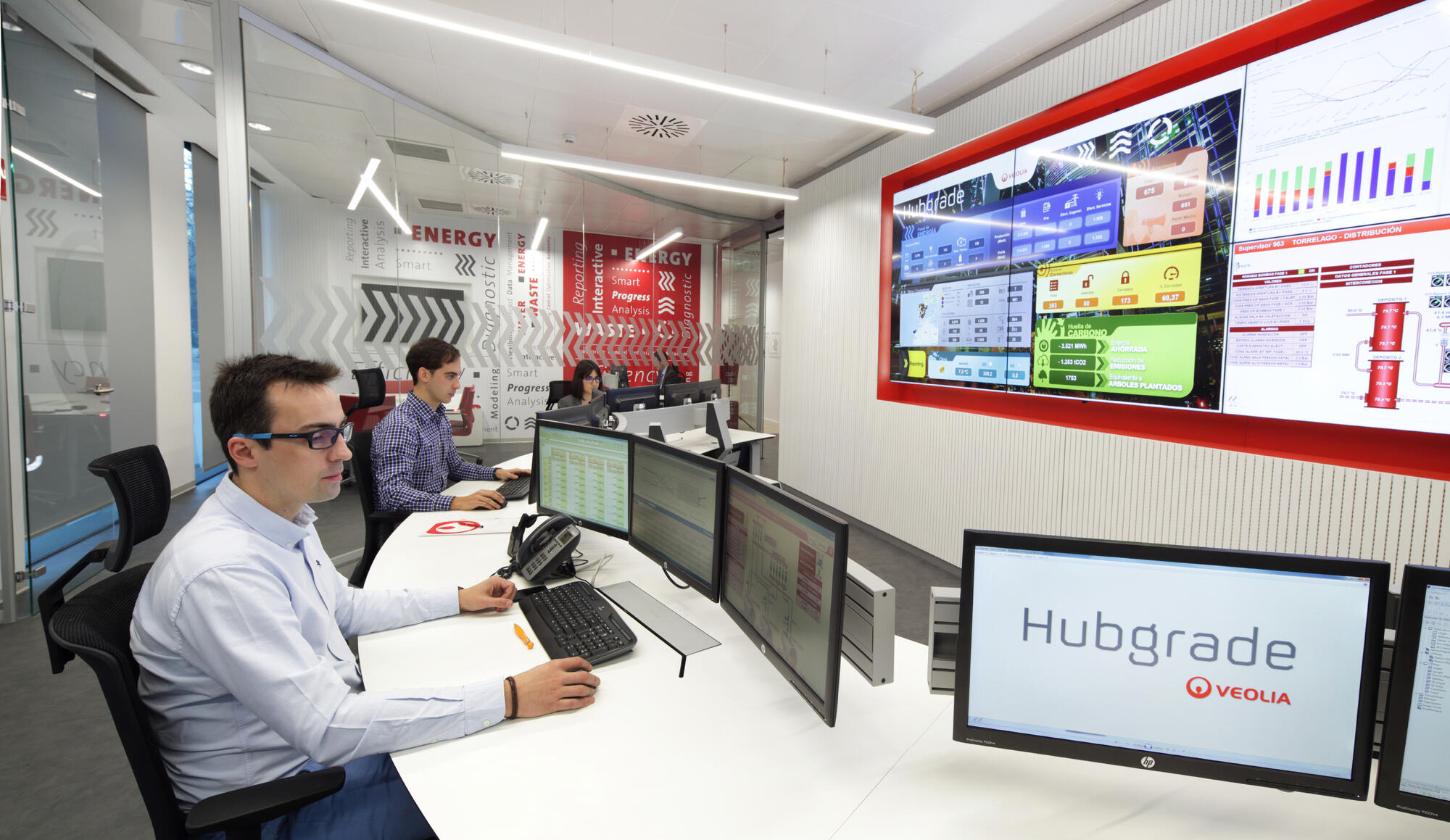
[Hubgrade](https://www.veoliawatertechnologies.co.uk/services/customer-portal-remote-monitoring) is Veolia’s digital water management platform. It combines real-time monitoring, data analytics and specialist support to give estates teams continuous visibility of water system performance.
For NHS healthcare environments, Hubgrade can help teams monitor critical systems across endoscopy, sterile services, dialysis, laboratories and wider estates. By turning live system data into actionable insight, it supports earlier intervention, stronger assurance and more predictable operational performance.
### Five benefits for NHS estates and clinical services:
For NHS trusts, the value of digital water monitoring is measured in avoided disruption, better assurance and more efficient use of estates resource. Hubgrade can support:
1. Fewer avoidable service interruptions
Early alerts help estates teams identify and respond to issues before they become system failures that affect clinical departments.
2. Stronger HTM and BS ISO Water quality assurance
Continuous monitoring and digital records can support audit preparation, trend analysis and evidence-based compliance conversations.
3. Less manual administration for estates teams
Automated data collection and reporting can reduce manual logging, helping teams focus on planned maintenance, service improvement and urgent priorities.
4. Better protection for patient pathways
Reliable water systems help reduce the risk of cancelled procedures, delayed appointments and avoidable disruption to planned care.
5. Improved efficiency and sustainability insight
Live performance data can help identify opportunities to optimise energy, chemical use and maintenance planning across the estate.
Whether supporting a large acute hospital, a centralised treatment plant or a single specialist department, Hubgrade can scale to the needs of the NHS estate. The result is a more transparent, proactive and controlled approach to healthcare water management.
## Case Study: How Halton General Hospital Resolved a Critical Water System Failure in 30 Minutes
Warrington and Halton Teaching Hospitals NHS Foundation Trust operates a [Thermapure](https://www.veoliawatertechnologies.co.uk/products/thermapure) 300 Duplex reverse osmosis system in the Endoscopy Department at Halton General Hospital. Since its installation in July 2019, the system has been integrated with Hubgrade, Veolia’s digital monitoring platform, and has consistently supplied compliant water to the department’s endoscopy washers.
The Challenge
Following a sudden change to the hospital’s incoming water supply, the system became unable to function, cutting off water supply to the endoscopy department.
Without water, the department could not operate. Procedures would need to be cancelled, patients rescheduled and clinical staff redeployed. For a busy NHS facility, this represented a significant disruption to patient pathways, operational targets and the continuity of planned care.
The Solution
Rather than dispatching engineers to site, Veolia’s service team used Hubgrade to diagnose the issue remotely. Through the Hubgrade portal dashboard, the team reviewed live system data, identified the root cause of the failure and recommended an effective remedy to the hospital’s on-site technicians.
The hospital’s process engineers then implemented the fix under remote guidance, enabling action to be taken immediately without waiting for an engineer visit.
The Result
Halton General Hospital had the system back up and running within 30 minutes, without requiring an on-site engineer visit. The endoscopy department resumed normal operations, patient procedures continued as scheduled and potential disruption to patient care was avoided.
This real-world example demonstrates how Hubgrade’s remote monitoring and expert support capabilities can help protect NHS healthcare facilities from costly downtime. By providing real-time equipment data and urgent alerts to users’ mobile devices, Hubgrade enables rapid problem-solving and helps keep critical clinical departments operational.
---
[Interested in Hubgrade for your healthcare site? Get in touch with one of our experts](https://www.veoliawatertechnologies.co.uk/contact)
## Tags
- [Process Water](https://blog.veoliawatertechnologies.co.uk/?tid=93391094251)
- [Science & healthcare](https://blog.veoliawatertechnologies.co.uk/?tid=93395983602)
## Related articles
## Discover *VWT UK*
### Latest news
[News](https://veoliawatertechnologies.co.uk/news/)
{|item.processed.title|}
Published: {|item.processed.published|}
### Latest webinars
[Webinars](https://veoliawatertechnologies.co.uk/webinars/)
{|item.processed.title|}
Date: {|item.processed.date|}
### Upcoming events
[Events](https://veoliawatertechnologies.co.uk/events/)
{|item.processed.title|}
Date: {|item.processed.date\_from|} - {|item.processed.date\_to|}
### Latest resources
[Resources](https://veoliawatertechnologies.co.uk/tech-resources/)
{|item.processed.title|}
Published: {|item.processed.published|}
| {|item.processed.city|}

## Sign up to blog notifications
Receive the latest blog updates.
{|error|}
By checking this box, you agree to **Veolia Water Technologies's** [Privacy Policy](https://veoliawatertechnologies.co.uk/privacy-policy) and you agree to receive information on our products and services.
Keep me informed
We respect your right to privacy. Click here to view our [contact policy](https://veoliawatertechnologies.co.uk/privacy-policy).
## Thank you for subscribing.
Please note that you can update your **preferences** at any time.
Return to blog
Note: If you do not receive any emails, please check your junk folder.
```json
{
"@context" : "https://schema.org",
"@type" : "BlogPosting",
"author" : {
"@type" : "Person",
"name" : "Becky Hill",
"url" : "https://blog.veoliawatertechnologies.co.uk/author/becky-hill"
},
"dateModified" : "2026-07-27T11:42:42.753Z",
"datePublished" : "2021-11-10T05:00:00.000Z",
"headline" : "How the NHS can reduce water system downtime with digital monitoring",
"image" : [ "https://blog.veoliawatertechnologies.co.uk/hubfs/Imported_Blog_Media/Untitled%20design%20(4).jpg" ],
"mainEntityOfPage" : {
"@id" : "https://blog.veoliawatertechnologies.co.uk/healthcare-hubgrade",
"@type" : "WebPage"
},
"publisher" : {
"@type" : "Organization",
"logo" : {
"@type" : "ImageObject",
"url" : "https://blog.veoliawatertechnologies.co.uk/hubfs/header-logo.png"
},
"name" : "Veolia Water Technologies"
}
}
```